
Table of Contents
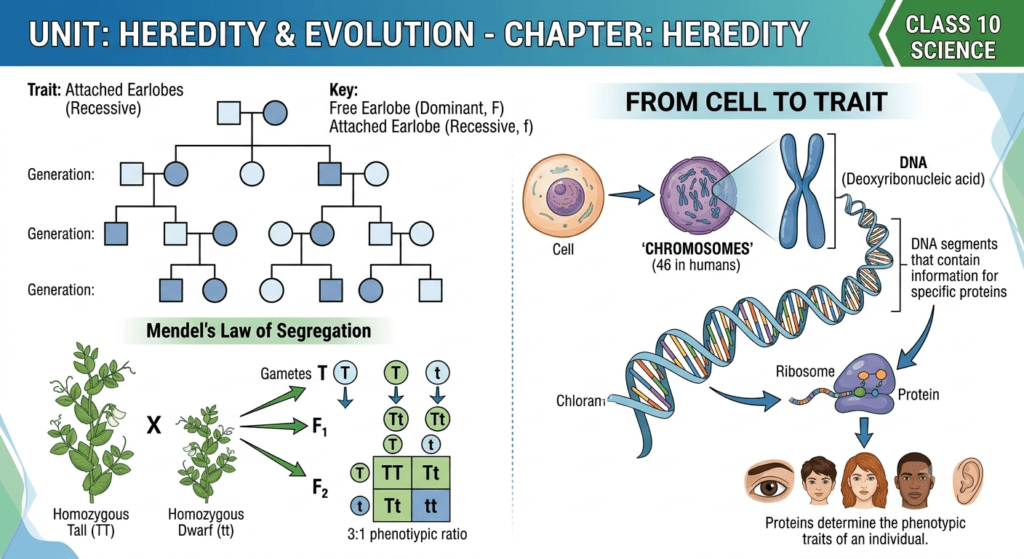
Living organisms have some recognizable heritable features, such as color of eyes, color of hair, and height. These are called characters.
The alternative forms of character are called traits. The inheritable characteristics or traits may be morphological, anatomical, physiological, or reproductive.
What is heredity?
The transmission of character or traits from parents to their offspring is called heredity. In other words, heredity means continuity of features from one generation to another generation.
Actually, the hereditary information is present in the sex cells, or gametes, from the parents. It means gametes link one generation to the next and pass the paternal and maternal features into the offspring.
Variation
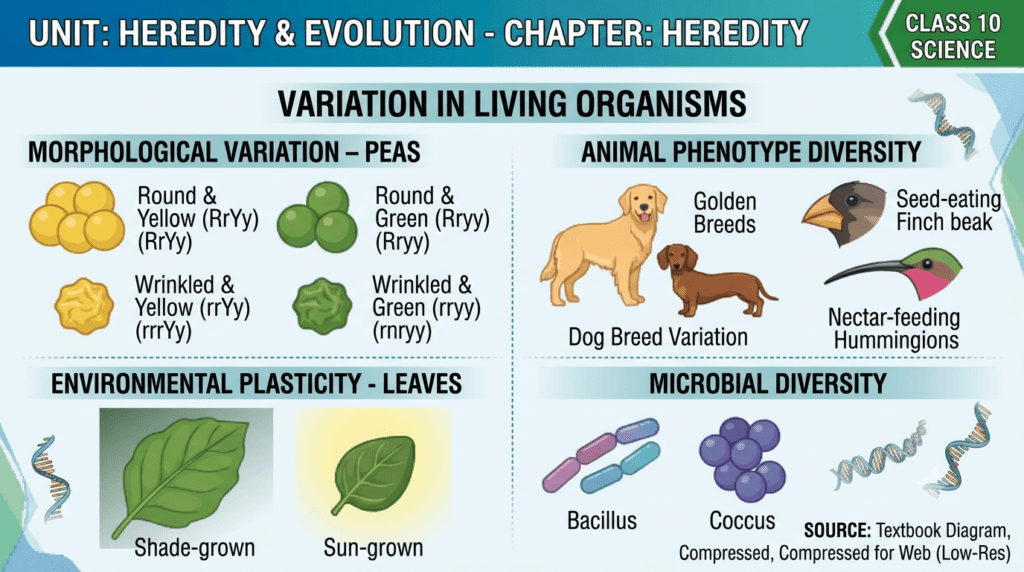
The difference in the characters among the individuals of the species is called variation. Variation is necessary for organic evolution. The great advantage of a species is that it increases the chance of survival in the changing environment.
Dominant and recessive genes
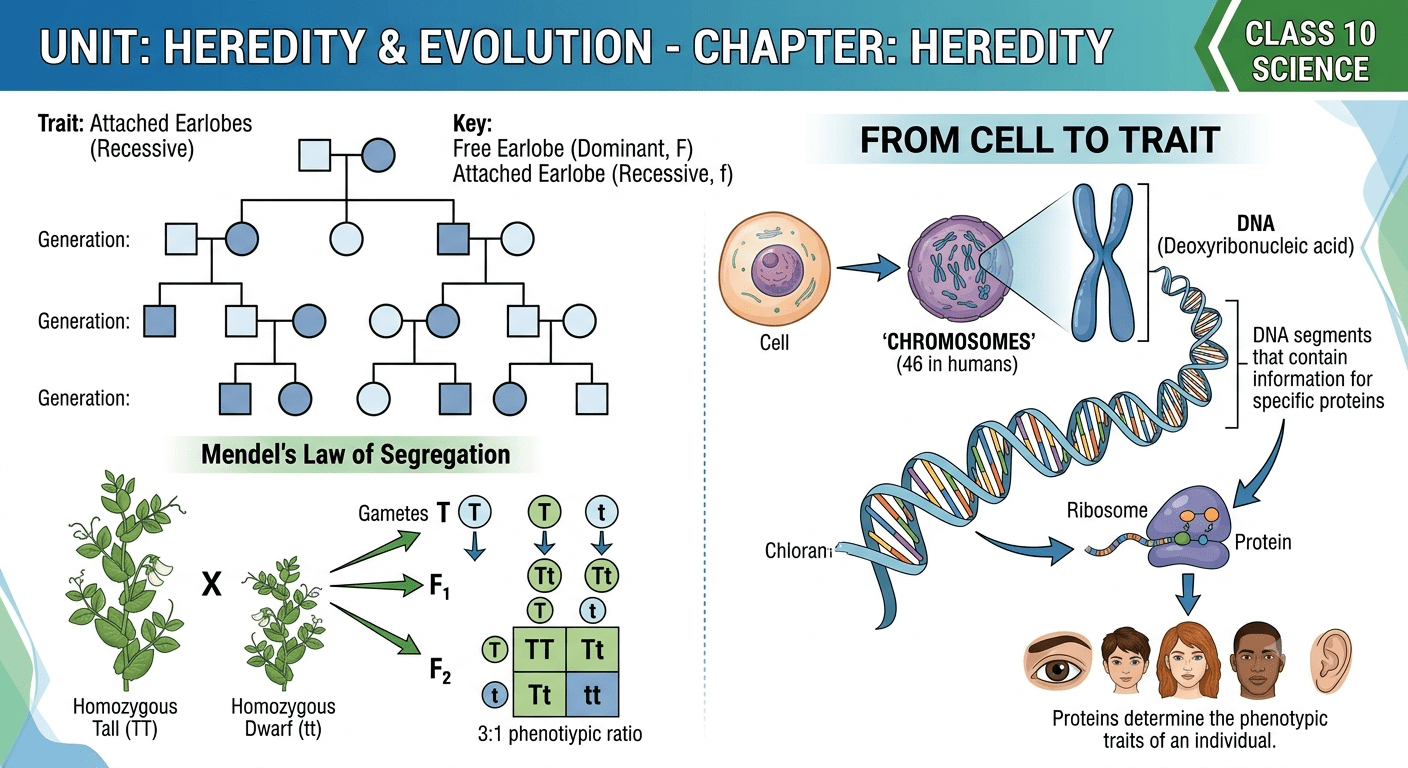
Gene: A gene is the unit of DNA on a chromosome that governs the synthesis of one protein that controls the specific character in an organism.
Genes are the actual units of heredity that transfer character from parents to their offspring during reproduction.
The genes that control the character are of two types.
- Dominant gene
- Recessive gene
Dominant gene: The genes that decide the appearance of an organism even in the presence of alternative genes are called dominant genes. It dominates the recessive genes for the same characteristics on the same chromosome. It is always written in capital letter.
Recessive gene: The genes that decide the appearance of an organism only if dominant genes are absent are called recessive genes. It is always written in small letters.
For example, in a pea plant, the dominant gene for tallness is T and the recessive gene for dwarfness is t.
What is genotype and phenotype
Genotype: A genotype shows the genetic constitution of an organism. Genotype is the description of a gene present in an organism. A genotype is always present in a pair of letters such as TT, Tt, and tt. The genotype for tallness is TT and Tt, and the genotype for dwarfness is tt.
Phenotype: The characteristics that are visible in an organism are called the phenotype. For example, tallness and dwarfness are the phenotypes of plants.
Also read: Quantum biology and morphogenetic fields
What is hybrid?
A hybrid is an organism produced by crossing two genetically different individuals. These parents may belong to different varieties, breeds, species, or, in rare cases, different genera. The offspring is known as a hybrid, and this process is known as hybridization.
Types of Hybrids
- Intraspecific Hybrid
- Formed by crossing two different varieties, strains, or breeds of the same species.
- Example: Crossing two varieties of rice or wheat to produce a high-yield crop.
- Interspecific Hybrid
- Formed by crossing two different species of the same genus.
- Example: A mule, produced by crossing a male donkey and a female horse.
- Intergeneric Hybrid
- Formed by crossing individuals from different genera.
- These hybrids are rare and usually produced through special breeding techniques.
- Example: Triticale, a crop developed by crossing wheat and rye
What is a genetic cross?
1. Monohybrid
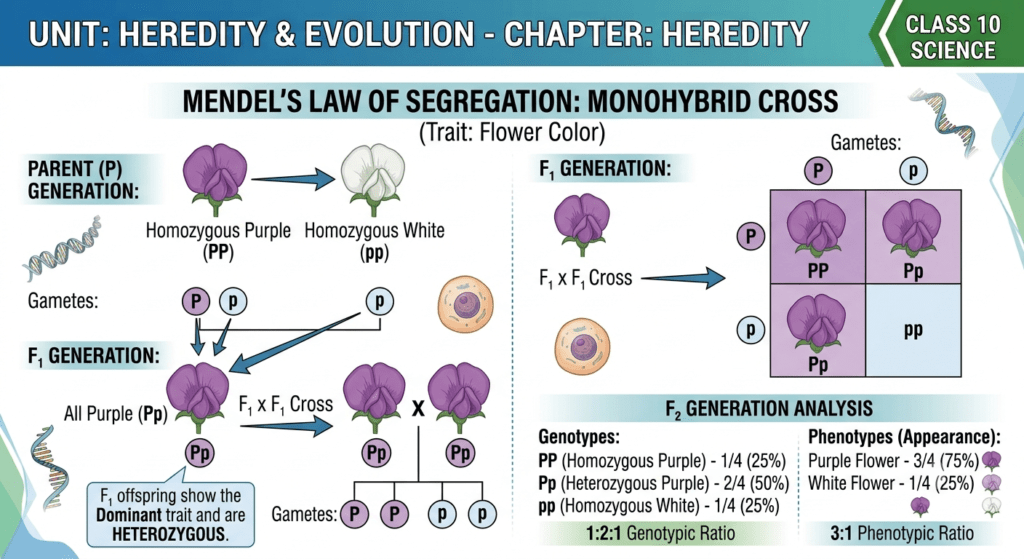
A monohybrid is an organism that is heterozygous for one trait, or a monohybrid cross is a cross involving one pair of contrasting traits.
Example:
- Trait: Plant height
- Parents: Tt × Tt
- T = Tall (dominant)
- t = Dwarf (recessive)
F₂ Phenotypic Ratio:
- 3 Tall : 1 Dwarf
Genotypic Ratio:
- 1 TT : 2 Tt : 1 tt
2. Dihybrid
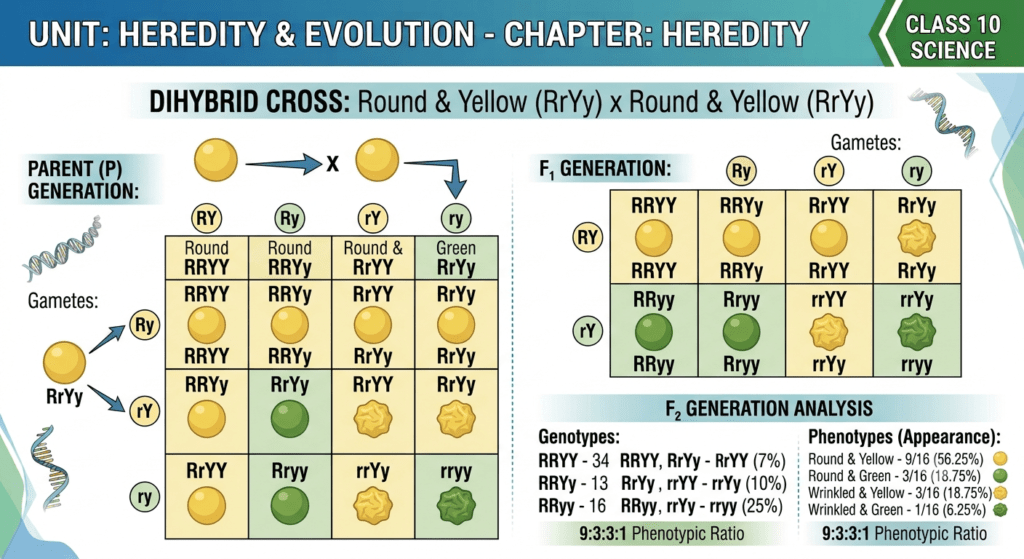
A dihybrid is an organism that is heterozygous for two traits, or a dihybrid cross is a cross involving two pairs of contrasting traits.
Example:
- Traits:
- Seed shape: R (Round) / r (Wrinkled)
- Seed color: Y (Yellow) / y (Green)
- Parents: RrYy × RrYy
F₂ Phenotypic Ratio:
- 9 Round Yellow : 3 Round Green: 3 Wrinkled Yellow : 1 Wrinkled Green
- Ratio: 9 : 3 : 3 : 1
Difference Between Monohybrid and Dihybrid
| Feature | Monohybrid Cross | Dihybrid Cross |
|---|---|---|
| Number of traits studied | One | Two |
| Number of gene pairs | One | Two |
| Example | Tt × Tt | RrYy × RrYy |
| F₂ Phenotypic Ratio | 3 : 1 | 9 : 3 : 3 : 1 |
| Mendel’s law demonstrated | Law of Segregation | Law of Independent Assortment |
Simple definitions for exams:
- Monohybrid: A hybrid involving one pair of contrasting traits.
- Dihybrid: A hybrid involving two pairs of contrasting traits.