
Table of Contents
Synthetic organs are also known as artificial organs. An artificial organ is a man-made device or tissue in the human body to replace, duplicate, and perform the function of a natural organ of the body. It is the incredible solution for failing organs; it is revolutionary in medical healthcare.
Watch this video—artificial organs
Synthetic organs are engineered systems designed to assist, support, or replace failing organs in the human body. These devices can take the form of whole organs like hearts, kidneys, and lungs or smaller components such as heart valves, joints, and skin. They are constructed from biomaterials, which can be either biological or synthetic, adapted for medical use to ensure compatibility with the human body. The development of artificial organs is a collaborative effort involving scientists, engineers, and medical professionals, focusing on replicating the functions of natural organs while addressing challenges like size, efficiency, and safety.
History of artificial organs
The first dialysis machine, the rotating artificial kidney, was invented in 1944 by Willem Johan Kolff, who is known as the ‘‘father of artificial organs” . Artificial organs have come a long way since then. At that time he met with stiff resistance from his hospital superiors, but his persistence paid off, and a million saved lives have been attributed to his first invention. He was actually the first to mix medicine with engineering.
An artificial organ is any machine, device, or other material used to replace the functions of a faulty or missing organ or other parts of the human body. Some parts of the body are harder than others. The heart has a function, and that’s to pump blood. The liver has biochemical and physiological functions that are hard to replicate.
Must-read: Nanotechnology
The artificial organ implantation is critical, since the patient is dependent on the artificial organ itself for his life. Organ transplantation is the treatment of choice, but candidates for transplantation wait a long time, and many die while waiting. Moreover, there are patients who are not suitable for transplantation because of age or other diseases. This book presents an overview of the present status of knowledge of artificial organs, including liver, pancreas, kidney, heart, cochlea, skin, stem cells, composite tissue allograft, and sphincters.
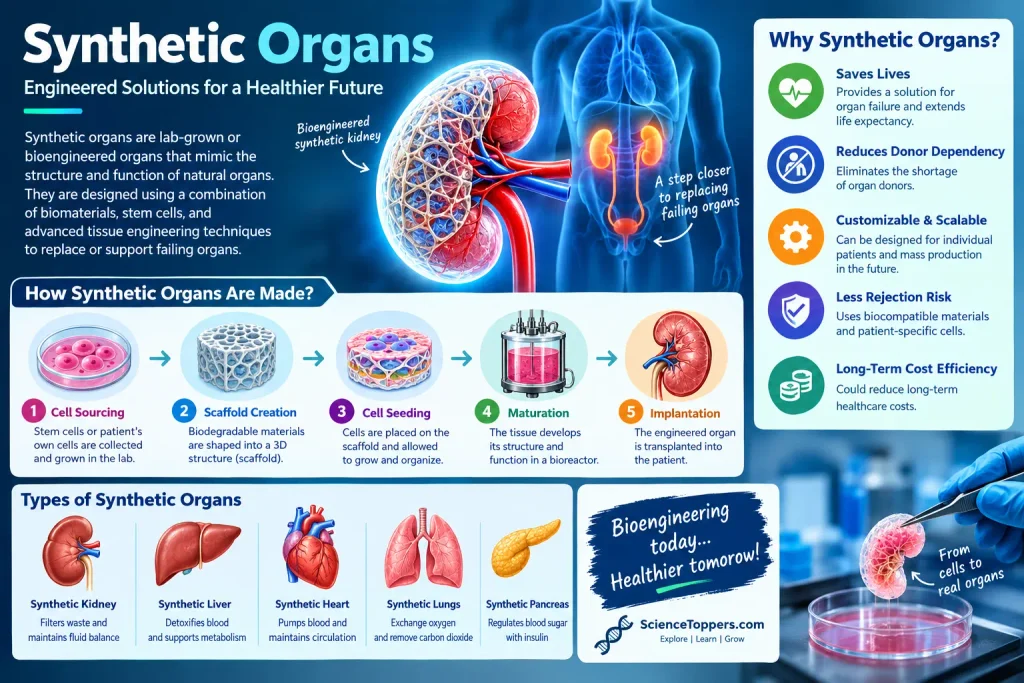
What is organ failure?
Organ failure happens when an organ stops working properly, which can be life-threatening. Common organs that can fail include the heart, kidney, lungs, and pancreas.
Organ failure is when one or more of your vital organs stop working. It can be a slow (chronic) or fast (acute) process. Vital organs are organs you cannot live without.
If a vital organ of yours starts to go down, you will need life support to aid or substitute the failing organ and to do the work it is no longer doing. Sometimes organs return, sometimes they don’t. If organ failure is terminal, it can be deadly.
Need of organ transplant?
Organ transplants are usually a treatment for organ failure, but there aren’t enough donor organs for everyone in need. Many people sadly pass away while waiting for a suitable organ, highlighting the urgent need for alternative solutions.
Organ transplantations may be the miracle of twentieth-century medicine. It is still the best therapy of terminal and irreversible organ failure by increasing life expectancies and improving quality of life.
Introducing synthetic organs
Synthetic organs, also known as artificial organs, are man-made devices created to do the same job as natural organs. These incredible inventions offer hope to patients by providing temporary or permanent replacement for failed organs.
Artificial heart
Artificial hearts are mechanical devices designed to pump blood throughout the body, helping patients awaiting heart transplant. They act as a bridge until a suitable donor heart becomes available for segment five, artificial kidneys transforming dialysis.
Artificial Kidney
An artificial kidney is a medical device that does the same work as a kidney.
“Some people may think of portable dialysis as an artificial kidney,” Dr. Roy said. “The Kidney Project’s artificial kidney is an implantable biomedical device that will function like a natural kidney and offer 24/7 treatment.
In the long run, the team hopes to replace all kidney functions, but the first models mimic kidneys in stage three or four kidney disease.
We want to get this out as fast as we can. “Our survey shows that patients value mobility and a life off dialysis more than the burden of taking pills and being on a restricted diet,” said Roy, MD. “People with stage three or four kidney disease can use medication, diet and exercise to stay off dialysis and maintain their kidney health.
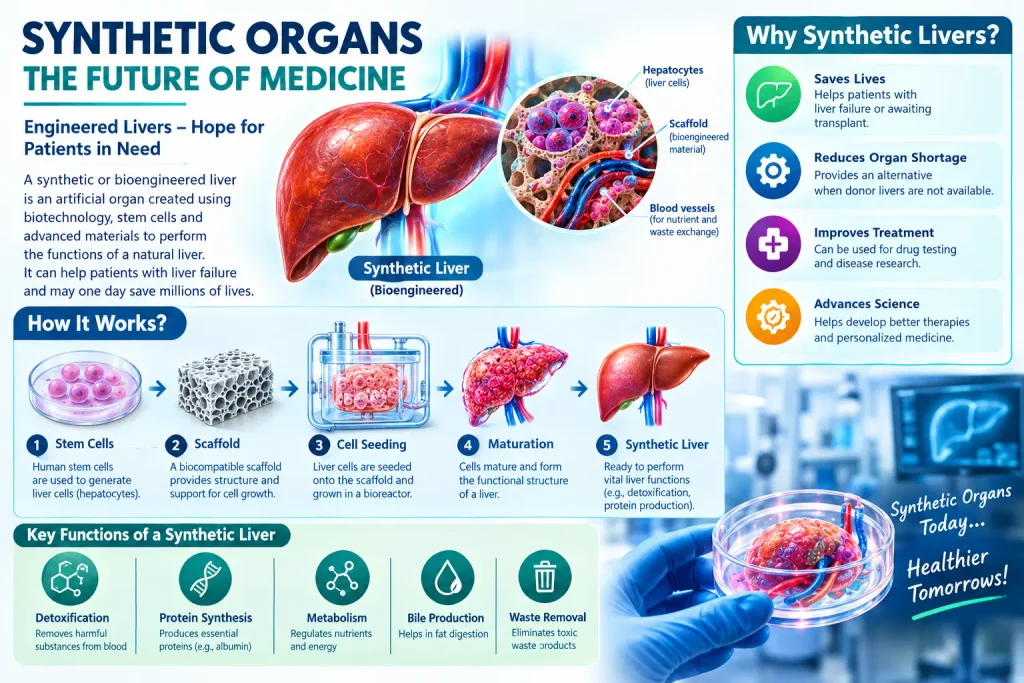
Artificial liver
An artificial liver is a medical support system that is used to help patients with severe liver disease temporarily to recover or as a bridge for liver transplant. The systems include nonbiological and biological devices, including bioartificial livers that use liver cells attached to the circulation.
Artificial liver support systems are at their early stages. Advances in cell-surface interaction and bioengineering in recent years have brought extrahepatic liver support research to an exciting new level. No one system has yet emerged as the ideal system, and several groups around the world are developing systems. Not surprisingly, given the complexity of liver functions. More and more the multi-factorial approach to liver support will be needed.