
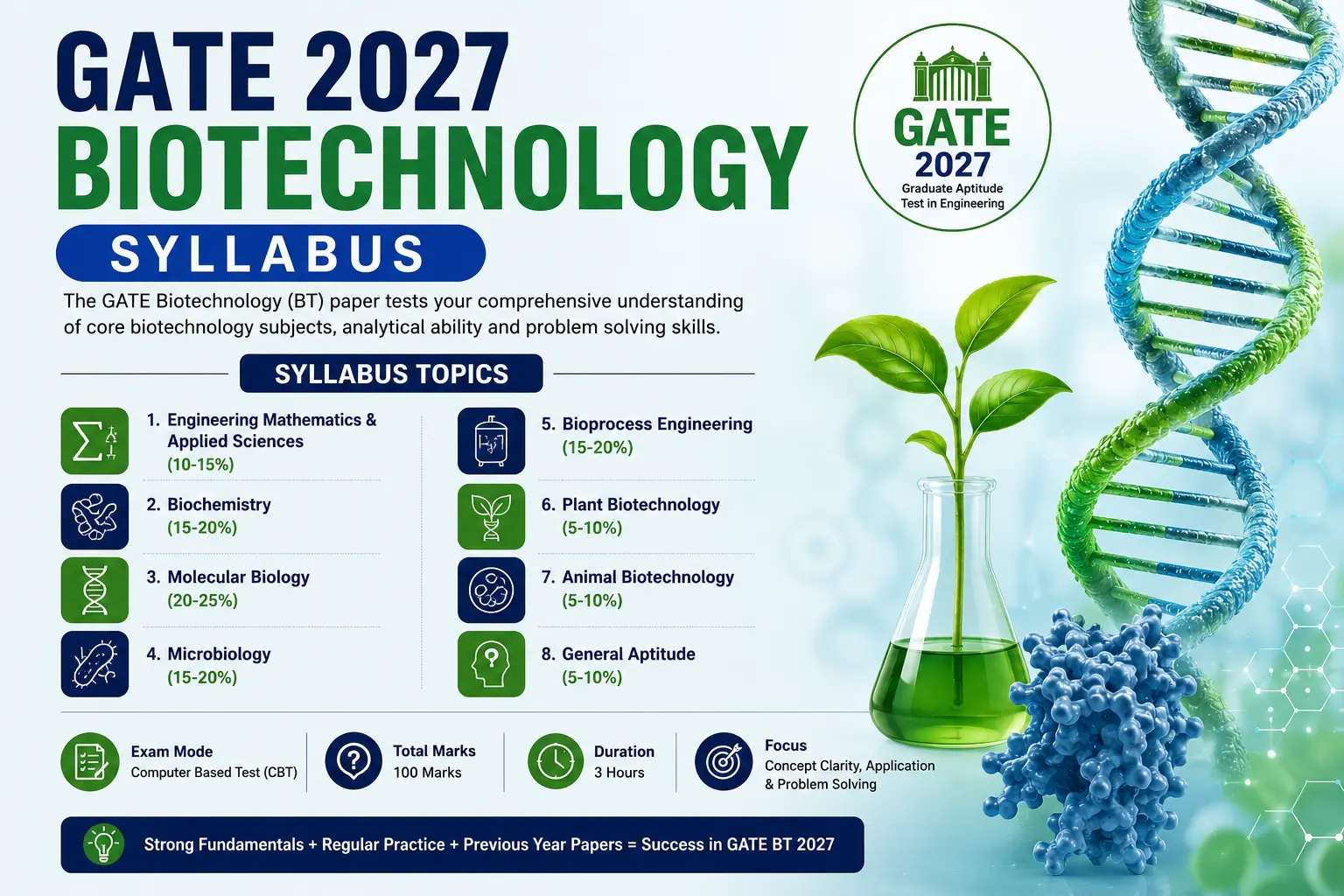

GATE is a national-level examination conducted by 7 IITs and IISc Bengaluru. The GATE 2027 syllabus has been released by IIT Madras. The GATE 2027 Biotechnology syllabus has been divided into 6 sections, including Engineering Mathematics; General Biology; Genetic, Cellular and Molecular Biology; Fundamentals of Biological Engineering; Plant, Animal and Microbial Biotechnology; and Recombinant DNA Technology.
To crack the GATE 2027 examination, you have to understand the syllabus, and you have to make your study plan according to the new syllabus. In this article, you can understand the GATE 2027 biotechnology syllabus, and you also find the comparison between the GATE 2026 and GATE 2027 syllabi.
Table of Contents
GATE 2027 Exam overview
GATE exam pattern remains the same as the previous year. There is no change in it. The exam syllabus includes 6 sections of biological science and biotechnology applications. The exam pattern overview is-
| Particulars | Details |
| Exams Name | GATE (Graduate Aptitude Test in Engineering) 2027 |
| Subject | Biotechnology |
| Subject code | BT |
| Organizing Institute | IIT Madras |
| Number of section | 6 |
| Mode of Exam | CBT (Computer-based Test) |
| Total marks | 100 |
| Total number of questions | 65 |
GATE 2027 Biotechnology syllabus
The GATE BT 2027 syllabus has been divided into 6 sections, including Engineering Mathematics, General Biology, Genetic, Cellular and Molecular Biology, Fundamentals of Biological Engineering, Plant, Animal and Microbial Biotechnology and Recombinant DNA Technology.
Section-1
Linear Algebra
- Matrices and determinants
- Systems of linear equations
- Eigenvalues and eigenvectors
Differential equations
- Linear and nonlinear first-order ODEs
- higher-order ODEs with constant coefficients
- Cauchy’s and Euler’s equations
- Laplace transforms
Probability and Statistics:
- Mean, median, mode and standard deviation
- Random variables
- Poisson, normal and binomial distributions
- Correlation and regression analysis
- Bayesian Statistics
Calculus:
- Multivariable calculus (limits, continuity, and differentiability)
- Partial derivatives, maxima and minima
- Sequences and series
- Test for convergence
- Multivariable calculus: Gradient, divergence, and curl (for applications in fluid mechanics, transport processes, etc.)
Numerical Methods:
- Solution of linear and nonlinear algebraic equations
- Integration by trapezoidal and Simpson’s rule
- Single-step method for differential equations
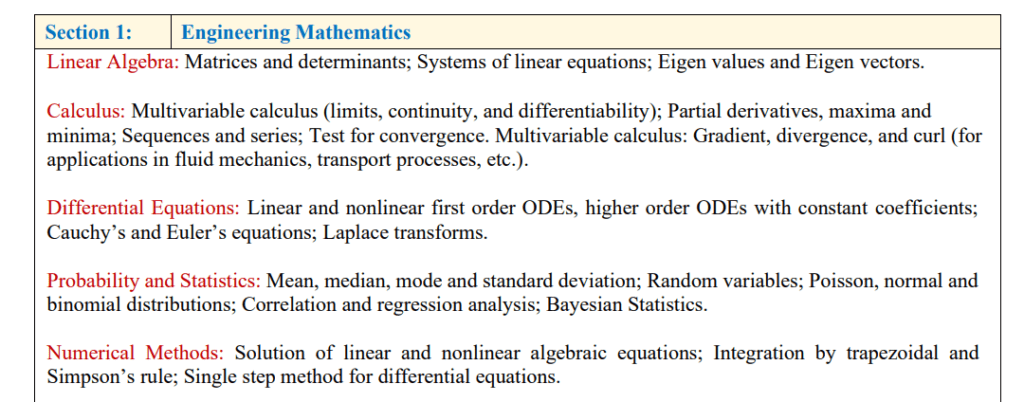
Section 2: General Biology
Biochemistry:
- Biomolecules – structure and function
- Biological membranes – structure, membrane channels and pumps, molecular motors, action potential and transport processes
- Basic concepts and regulation of metabolism of carbohydrates, lipids, amino acids and nucleic acids
- Metabolism: Regulation of metabolism of carbohydrates, lipids, amino acids, and nucleic acids
- Detailed pathways like glycolysis, citric acid cycle, and fatty acid oxidation
- Photosynthesis, respiration and electron transport chain
- Enzymes – Classification, catalytic and regulatory strategies
- Enzyme kinetics – Michaelis-Menten equation
- Enzyme inhibition – competitive, non-competitive and uncompetitive inhibition
Microbiology:
- History of Microbiology, Bacterial classification and diversity
- Bacterial cell wall composition, Gram-positive and Gram-negative bacteria, Archaea, Methods in microbiology
- Microbial growth and nutrition
- Operon – Lac, Trp and Ara operon, Nitrogen fixation
- Microbial diseases and host-pathogen interactions
- Antibiotics and antimicrobial resistance, Two-component systems (TCS), bacterial communication
- Viruses – structure and classification
Immunology:
- Primary and Secondary lymphoid organs
- Innate immunity and Inflammation
- Cytokines and Chemokines
- Complement system
- Effector responses: Cellular and Humoral Immunity
- Molecular basis of Antibody diversity and function
- Polyclonal and Monoclonal antibodies
- T-cell and B-cell development
- Memory responses
- Major Histocompatibility complex (MHC)
- Antigen processing and presentation
- Regulation of immune responses
- Immune tolerance
- Hypersensitivity
- Autoimmunity and Immunodeficiency
- Graft-vs-host disease
- Immunization and vaccines
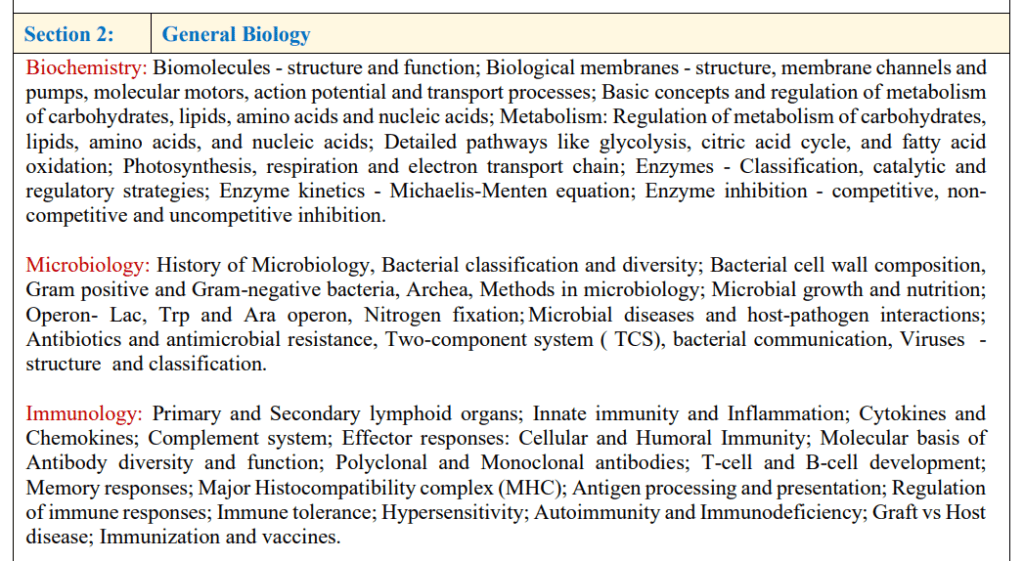
Section 3: Genetic, cellular and Molecular biology
Genetics and Evolutionary Biology:
- Mendelian inheritance
- Gene interaction
- Complementation
- Linkage, recombination and chromosome mapping
- Extrachromosomal inheritance
- Microbial genetics – transformation, transduction and conjugation
- Bacterial gene mapping
- Horizontal gene transfer and transposable elements
- Chromosomal variation
- Sex Determination
- Genetic disorders
- Population genetics
- Epigenetics
- Selection and inheritance
- Adaptive and neutral evolution
- Genetic drift
- Species and speciation
Cell Biology:
- Eukaryotic cell structure
- Cell cycle and cell growth control
- Cell-cell communication
- Cell signalling and signal transduction
- Non-cell autonomous cell signalling
- Post-translational modifications
- Protein trafficking
- Cell death and autophagy
- Extra-cellular matrix
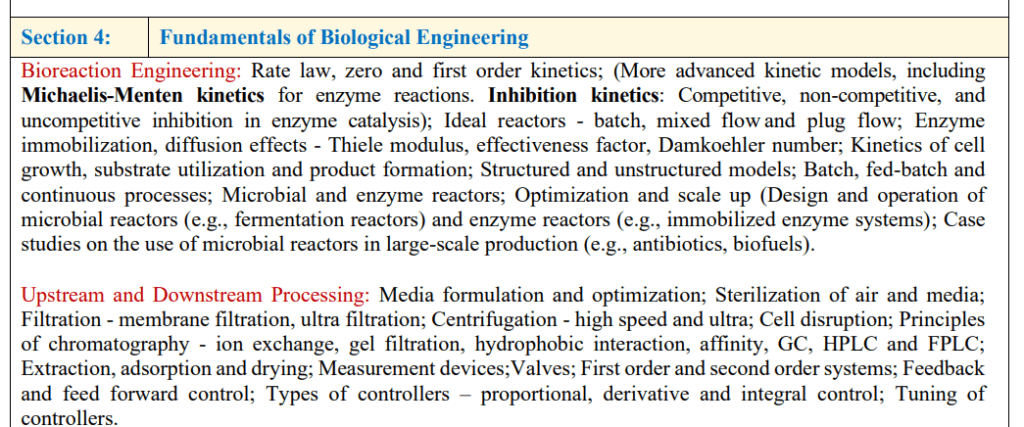
Section 4: Fundamentals of Biological Engineering
Upstream and Downstream Processing:
- Media formulation and optimization
- Sterilization of air and media
- Filtration – membrane filtration, ultrafiltration
- Centrifugation – high speed and ultra
- Cell disruption
- Principles of chromatography – ion exchange, gel filtration, hydrophobic interaction, affinity, GC, HPLC and FPLC
- Extraction, adsorption and drying
- Measurement devices: Valves
- First-order and second-order systems
- Feedback and feedforward control
- Types of controllers – proportional, derivative and integral control
- Tuning of controllers
Bioreaction Engineering:
- Rate law, zero and first-order kinetics
- More advanced kinetic models, including Michaelis-Menten kinetics for enzyme reactions
- Inhibition kinetics: Competitive, non-competitive, and uncompetitive inhibition in enzyme catalysis
- Ideal reactors – batch, mixed flow and plug flow
- Enzyme immobilization, diffusion effects – Thiele modulus, effectiveness factor, Damköhler number
- Kinetics of cell growth, substrate utilization and product formation
- Structured and unstructured models
- Batch, fed-batch and continuous processes
- Microbial and enzyme reactors
- Optimization and scale-up (Design and operation of microbial reactors (e.g., fermentation reactors) and enzyme reactors (e.g., immobilized enzyme systems))
- Case studies on the use of microbial reactors in large-scale production (e.g., antibiotics and biofuels)
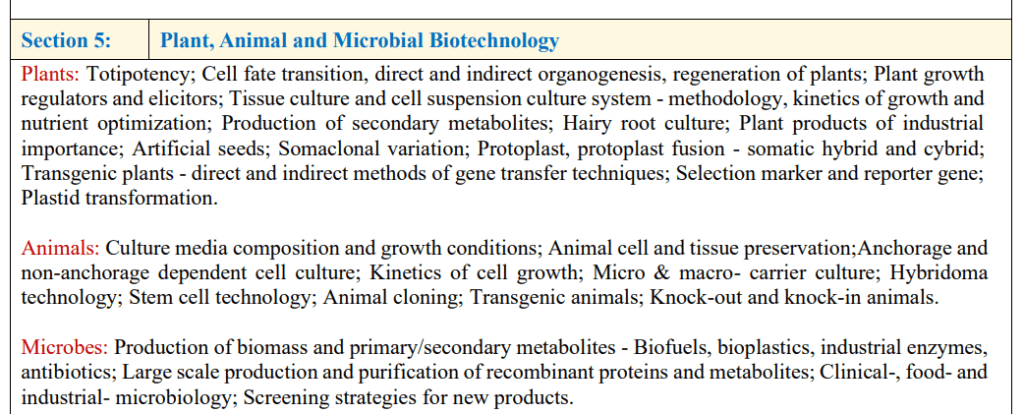
Section 5: Plant, Animal and Microbial Biotechnology
Animals:
- Culture media composition and growth conditions
- Animal cell and tissue preservation
- Anchorage- and non-anchorage dependent cell culture
- Kinetics of cell growth
- Micro & macro-carrier culture
- Hybridoma technology
- Stem cell technology
- Animal cloning
- Transgenic animals
- Knock-out and knock-in animals
Plants:
- Totipotency
- Cell fate transition, direct and indirect organogenesis, regeneration of plants
- Plant growth regulators and elicitors
- Tissue culture and cell suspension culture system – methodology, kinetics of growth and nutrient optimization
- Production of secondary metabolites
- Hairy root culture
- Plant products of industrial importance
- Artificial seeds
- Somaclonal variation
- Protoplast, protoplast fusion – somatic hybrid and cybrid
- Transgenic plants – direct and indirect methods of gene transfer techniques
- Selection marker and reporter gene
- Plastid transformation
Microbes:
- Production of biomass and primary/secondary metabolites – Biofuels, bioplastics, industrial enzymes, antibiotics
- Large-scale production and purification of recombinant proteins and metabolites
- Clinical-, food- and industrial-microbiology
- Screening strategies for new products
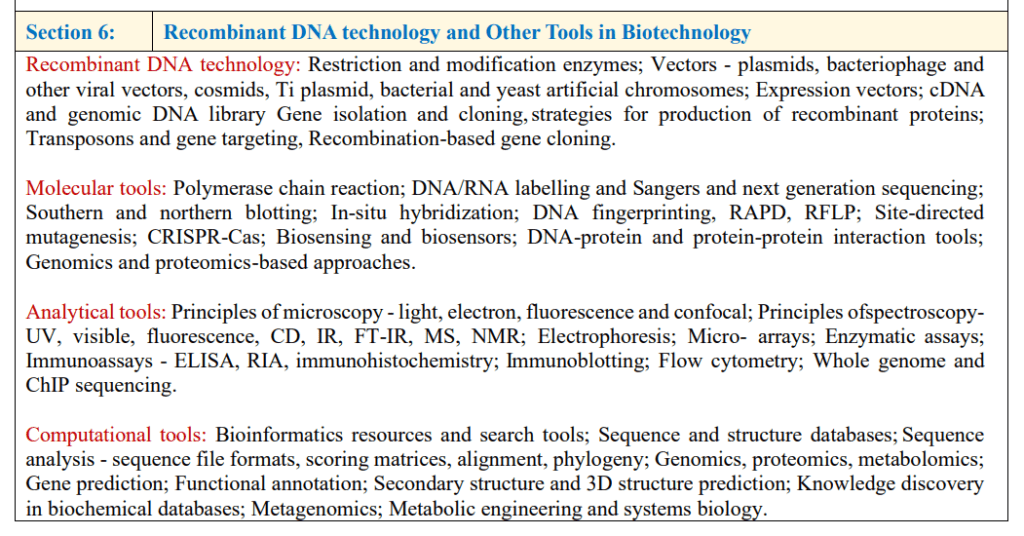
Section 6: Recombinant DNA technology and Other Tools in Biotechnology
Recombinant DNA technology:
- Restriction and modification enzymes
- Vectors – plasmids, bacteriophages and other viral vectors, cosmids, Ti plasmid, bacterial and yeast artificial chromosomes
- Expression vectors
- Gene isolation and cloning, strategies for production of recombinant proteins
- Transposons and gene targeting
- Recombination-based gene cloning
Molecular tools:
- Polymerase chain reaction
- DNA/RNA labelling and Sangers and next-generation sequencing
- Southern and northern blotting
- In-situ hybridization
- DNA fingerprinting, RAPD, RFLP
- Site-directed mutagenesis
- CRISPR-Cas
- Biosensing and biosensors
- DNA-protein and protein-protein interaction tools
- Genomics and proteomics-based approaches
Computational tools:
- Bioinformatics resources and search tools
- Sequence and structure databases
- Sequence analysis – sequence file formats, scoring matrices, alignment, phylogeny
- Genomics, proteomics, metabolomics
- Gene prediction
- Functional annotation
- Secondary structure and 3D structure prediction
- Knowledge discovery in biochemical databases
- Metagenomics
- Metabolic engineering and systems biology
Analytical tools:
- Principles of microscopy – light, electron, fluorescence and confocal
- Principles of spectroscopy – UV, visible, fluorescence, CD, IR, FT-IR, MS, NMR
- Electrophoresis
- Micro-arrays
- Enzymatic assays
- Immunoassays – ELISA, RIA, immunohistochemistry
- Immunoblotting
- Flow cytometry
- Whole genome and ChIP sequencing
GATE 2027 Biotechnology syllabus vs 2026 syllabus
There are some changes in the GATE 2027 biotechnology syllabus that have occurred. The changes occur in almost all the sections and almost in every subject.
Changes in GATE 2027 Biotechnology syllabus – click here
Download GATE 2027 Biotechnology syllabus PDF – click here
GATE 2027 official website – click here
GATE 2027 all information – click here
Exam paper pattern
The GATE 2027 exam pattern is very important to know for cracking the exams. There are no changes occurring in the exam pattern in GATE 2027.
| Feature | Details |
|---|---|
| Mode of exam | Computer-Based Test (CBT) |
| Duration | 3 hours |
| Total marks | 100 |
| Total questions | 65 |
| Question types | MCQ, MSQ (Multiple Select Questions), and NAT (Numerical Answer Type) |
| Language | English |

1 thought on “GATE 2027 Biotechnology Syllabus | New vs old syllabus”
Very helpful information….